Sorbonne Revisited: 70 Years, One Woman’s Story
France Today
Irvina Lew Profile
First published: March 18, 2026, by Josie Sharp.
L’Université de Sorbonne has been standing tall in the 5th arrondissement of Paris since 1257, making it the fourth-oldest university in all of Europe. When people think of this prestigious institution, their thoughts often turn to its famous alumni, including scientist Marie Curie, literary great Victor Hugo and philosopher Simone de Beauvoir, each of whom has left their distinctive mark on history.
But what of the American alumna, Irvina Lew, now 87, who followed her dream of studying in France one summer in 1958, when she was just 19? And what did she make of it when she returned in 2025?
I sit down with Irvina to hear her life’s story, which takes me back decades to the beginning of the Fifth Republic in France, when traces of the post-war era still lingered.
It was 1958, and a 19-year-old Irvina was studying at the College of William and Mary in Williamsburg, Virginia, when she noticed an advertisement on a bulletin board promoting a summer study programme in Paris. The course would count toward her college credits back in the United States, meaning she would graduate early, an important detail that helped persuade her father to let her go.
Her mother, however, was more than happy for her to spend the summer abroad. She disapproved of Irvina’s boyfriend, and although the couple had recently broken up, she believed time away would help ensure they didn’t get back together.
So off Irvina went to live in Paris for eight weeks with her friend Linda, staying in a small hotel on 6 rue de Loussac on the Left Bank, just three streets down from the Sorbonne, which was owned by a rather ominous landlady.
Although they never learned her name, she became a prominent figure in their lives. She begrudgingly let them in when they returned late, spent her days scrubbing the pavement outside, and religiously used ivory soap, Irvina recalls.
She was also always fully dressed in black to honour someone she had lost to the Second World War, which had ended 13 years earlier, though whose identity they never found out.
“The rest of the French public looked like they had walked straight off the set of Gigi,” Irvina says, remembering crowds dressed in plaid skirts, neat jackets and classic Parisian style similar to that of the hit 1958 film.
They lived on jambon fromage while studying French grammar and conversation during the week, and in their free time, they explored Paris and beyond, including a day trip to the World’s Fairs in Brussels, where Irvina ate her very first hamburger.
“My friend’s uncle was a bigwig at General Motors and arranged a chauffeur and massive 1958 Oldsmobile for our summer in Paris,” says Irvina. “Americans were quite revered in France at the time, and the boys seemed more interested in the car than in us!”
But the boys still paid attention. Irvina says they were very different from the ones she’d left back home, more direct, bold, and openly flirty.
The Parisian youth of 1958 seemed far more forward than the boys she knew in America, where the social ‘rules’ of dating were much stricter. In France, people were far more relaxed about love and romance, a sentiment that her friend Linda adopted, and she went on to have a love affair on their trip to Italy.
After two months of thrills in Europe, Irvina returned to America, and in one year, she graduated from college, got married, bought a house, had a baby and began teaching French as a substitute teacher. It was nearly 20 years before she had the money to return to her favourite city, but it was always her dream.
In 1994, she retired from teaching and became a travel journalist, building a collection of stories from her journeys across France before publishing her autobiography, Forays in France: A Flavorful Memoir. The book is a reminiscence of her life and of France’s role, tracing everything back to a single summer she spent studying at the Sorbonne in Paris.
While Irvina’s love for travel and writing was sparked at the Sorbonne, she had long left her 19-year-old self behind. That was, until life came full circle, when she received an e-newsletter, the digital echo of the bulletin she had seen all those decades ago, inviting her to study at the L’Université de Sorbonne once more.
L’université d’été et d’hiverare seasonal educational programmes run by Sorbonne University each year. Its summer courses have been offered since 2011, and the winter session has been held each year since 2020. When Irvina returned in 2025, it was the first time the course was held in person.
“It’s incredible that somebody can come to the Sorbonne and study there in the summer without necessarily having a degree,” says Carolina Schleier, assistant project manager at the Sorbonne’s L’université d’été et hiver.
“They sit there like all these academics who have been there before, and have the privilege of learning from top university lecturers.”
Since they first began, the Sorbonne’s summer and winter courses have welcomed hundreds of Francophiles of all ages and nationalities. In January 2026 alone, 171 people from 34 nationalities participated.
Irvina returned to the Latin Quarter that she had wandered five decades earlier, reliving her youth and reviving her love for learning.
While studying French literature and feminist poetry, she discovered that Jean-Paul Sartre, a fellow Sorbonne University alumnus, used to sip coffee and have deep discussions at the famous Café de Flore with Albert Camus, just one arrondissement away from where she had been studying all those years ago.
“I was a bit embarrassed to learn they were just one mile away while I was discovering Paris, never having a serious discussion,” says Irvina. “I’ve read all their work now, and it was great to learn about them in my classes.”
Irvina has lived a life full of learning and travel, earning a scholarship to study at the University of Salamanca in 1992 and receiving her teaching certification from New York University in 1959. She credits her lifelong curiosity and learning for keeping her sharp over the years.
“So many people my age only talk about the past, but who wants to be someone whose life exists only in memory? She says, “History belongs in books, not in people.”
Buy Forays in France:https://www.foraysinfrance.com
Sign up for the 2026 Sorbonne summer course: https://lettres.sorbonne-universite.fr/en/academics/sorbonne-summer-university
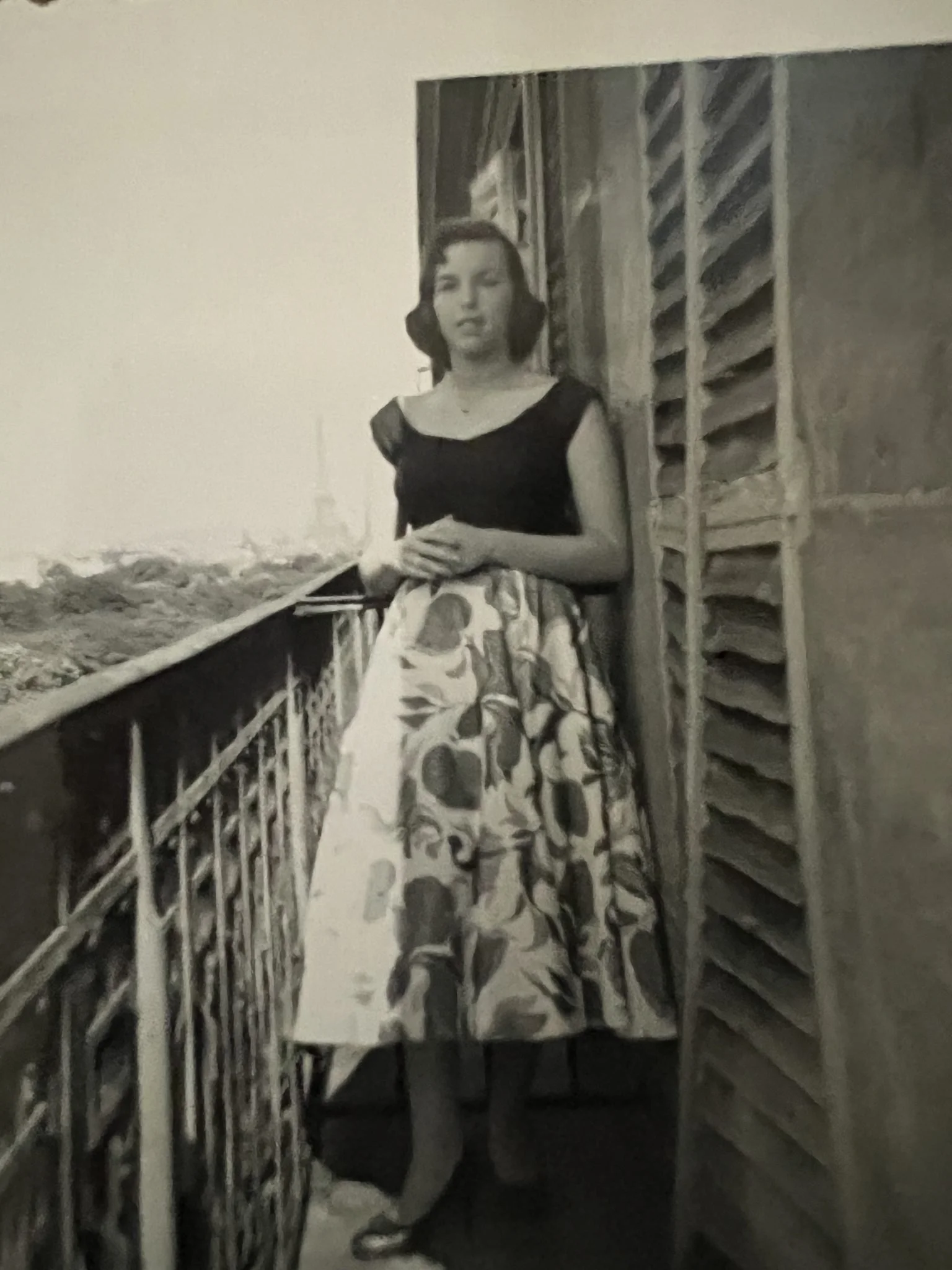
Irvina Lew
Studying at L’Université de Sorbonne in 1958 at 19 years old.
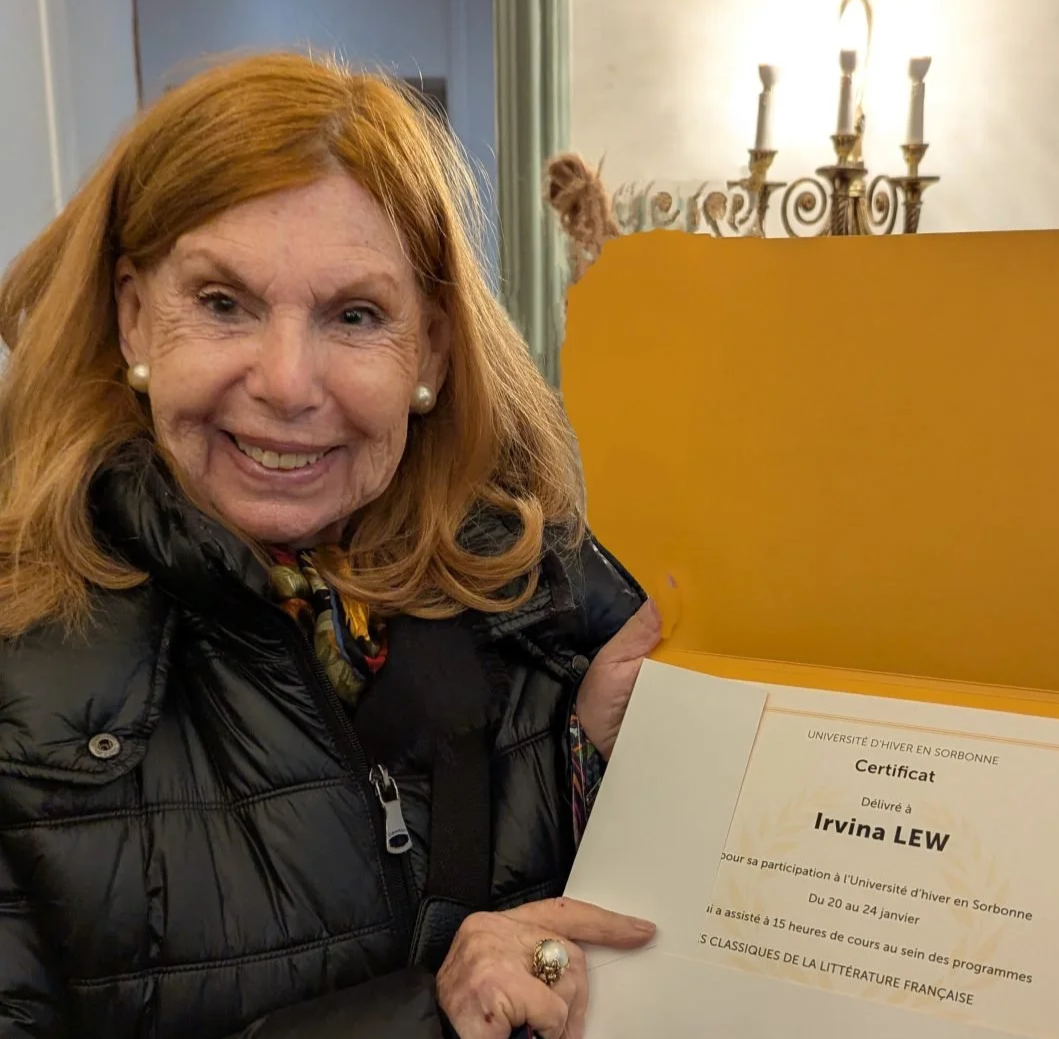
Irvina Lew at the Sorbonne in 2025